


Salesians. Rector Major: Intervention at the conclusion of the VIII International Congress of Mary Help of Christians
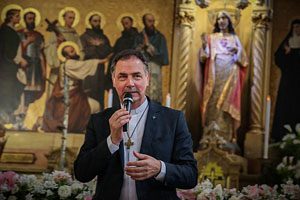 I’d like to start with a Hail Mary. We are here in the house of the Mother, living an authentic Marian pilgrimage and, as a sign of how much we love her Son and how much we love God, together we say: “Hail Mary”. They asked me to conclude these days. I would like to offer you a summary of what I think should be considered in our Marian journey as a Salesian Family. I would like to do it in a simple way and touching on aspects of our daily life.
CHAPTER 1: my first contact with the Virgin
I’ll start by talking about me. I was wondering these days: how was my Marian devotion born? I ask all of you so that you too can think of how your love for Mary was born.
Let me tell you my story: I was born in a small fishing village and my first contacts with the faith and with the Virgin were my grandmother and my mother. My grandmother Carmen was born ten years after the death of Don Bosco, that is, in the very century of Don Bosco and lived many years. She was an illiterate woman, she could not read, she could not write but she had a great devotion to the Virgin. She went to hear the mass in Latin, who knows what she understood… well, she understood the love of the Virgin. I remember her house, where I slept and remember this great painting of the Our Lady of Mount Carmel redeeming the souls of purgatory and I remember my grandmother and my mother reciting the rosary. I have in mind the scene of my father with my uncle in the sea, and in the evenings and nights of winter my grandmother and my mother praying the rosary. I didn’t understand much, but I still have their witnesses. To pray for those who were in the sea whose distant lights we saw. A few words, little theology, but I learned that the Virgin in my family was important!
CHAPTER 2: the origin of my Salesian Marian devotion.
I was a student in a Salesian school and I discovered how beautiful the love of the Virgin was through beautiful images of Mary Help of Christians that I saw in the Salesian house. There, they taught me the three Hail Marys and to visit the Blessed Sacrament. We also celebrated the feast of Mary Help of Christians. This makes me think: we, the educators of the faith, must be attentive to our iconoclastic style, attentive to our modernism which maintains that images are useless or that a prayer to Mary Help of Christians is in vain. Be careful because we do not offer anything if we cannot overcome this. And I say this without wanting to enter into an ideological war, but I speak from experience where they taught me to love Mary through the beauty of a statue, a Hail Mary and a feast.
CHAPTER 3 : the presence of Mary in my life.
Young people often ask me to tell them about special experiences I have had and in which I have felt the strength of the Virgin. I feel like disappointing them, but I have to say: “None!”. I have not had any apparitions or things of this kind, except a certainty that I want to share and that is a certainty of the Christian life, of the Christian life in daily life. It is the certainty that in my life Mary Help of Christians, the Mother, is always present. I have experienced what it means to feel guided and to feel the grace that comes to me from the prayer of others, for this reason I understand so much Pope Francis when he asks us to pray for him. I am certain that the Blessed Mother holds my hand and accompanies and guides me every day. But this is played out in the personal sphere. That is why each of us has his/her own experience, because each of us could say how Jesus and Mary are present in his/her life and how they manifest themselves. I am certain that the Blessed Mother continues to do extraordinary things.
CHAPTER 4: To say Mary for us, the Salesian Family is to say Don Bosco.
First scene: Don Bosco left us in the Memoirs of the oratory the dream he had at the age of 9 that deeply impressed him. How many times have we seen him and remember the phrase: “I will give you a teacher”. And Don Bosco tells us that he has kept this very much in his heart.
Let’s see the second scene of this chapter: a 72-year-old Don Bosco who goes to bless, to consecrate the Basilica of the Sacred Heart of Rome, that 17 May 1887, 7 months before his death, in which he celebrates his last Eucharist. On the right altar of Mary Help of Christians, it is 6:30 in the morning. Don Bosco is old, with little voice that almost fails to celebrate mass, he stops, delays. After many interruptions, the Eucharist ended and, in the sacristy,, he was asked what he had, whether he felt sick. Don Bosco, an elderly man, crying with deep emotion, says: “It happened to me that now I have understood everything, that she has done everything in these years”. This is the synthesis of Don Bosco’s life and Marian life. But in between there are 62 years between that day and his nine years of dreaming, of a Don Bosco who walks, who makes decisions, who asks for help, who asks the Mother. In these 62 years Don Bosco has the certainty that the Mother has always accompanied him.
CHAPTER 5: The presence of the mother in the oratory.
The other day, one of our brothers said an expression on which I totally agree, namely that Mamma Margaret is the founder of the oratory. I would say that she is the founder along with her son. Mamma Margaret was the founder with her son of the oratory of Valdocco. Don Bosco took her with him and they began to live in that house and to welcome boys. Did Don Bosco have a project? No, his was a project of the heart: he lives with his mother and wants to welcome the boys and give them the warmth of a house. Have you ever thought that Don Bosco has always wanted to keep with him the figure of a mother in the oratory? A PHYSICAL figure. So we remember Mamma Margaret as the mother of the oratory, the mother of Michele Rua, the mother of Gastaldi, with whom he had dialogues and meetings and many other moments of a mother who was part of the life of the oratory. Don Bosco knew that his boys needed the love of a mother because they didn’t have one.
Don Bosco sensed that he had to make his boys understand that the other mother, the Mother of Jesus, the Mother of Heaven, would always have taken them by the hand, would have loved them, would have guided them.
Don Bosco, who makes sure that his boys keep an “revitalized” heart. The Mother is the one to whom he goes and through Mary he brought his children very close to the encounter with Jesus. He followed a whole spiritual pedagogy. It is a Don Bosco who does all this… devotion to the Our Lady of Consolation, devotion to the Immaculate Mary, devotion to the Help of Christians. We can’t say that Don Bosco never, for a single day, hasn’t stimulated his boys to love Mary. It seems to me that this is another great lesson. Before I said aloud: “Beware of the iconoclastic current that says: let’s stop with this nonsense”. This nonsense marked my life, this nonsense marked the life of many brothers. Every day a word about Mary.
CHAPTER 6: Be careful not to misunderstand devotion.
Let me explain myself better: on this iconoclastic line of some currents, it’s enough to say that devotion is silly, that it’s something for the elderly only, to stigmatize something that is very profound. Let me explain myself better: I’m addressing my grandmother (who will ask why I’m naming her so much today
Leave a Reply